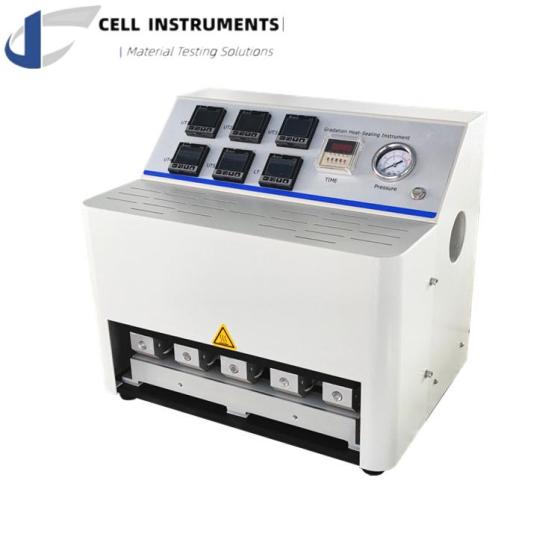
Gradient Heat Seal Tester for Flexible Packaging – High-Efficiency Lab Heat Sealing Machine
GET A FREE QUOTE NOW
Key Features: 4K Ultra HD resolution for exceptional road detail; Wi-Fi connectivity for seamless smartphone integration; real-time video streaming and remote control via mobile app.
Application
A Heat Seal Tester is a crucial device in the packaging industry, evaluating the heat-sealing properties of materials like films, laminates, and packaging components. It ensures the integrity and strength of seals vital for packaging various products, including food, pharmaceuticals, and electronics. Our Heat Seal Tester simulates packaging conditions by applying precise heat and pressure over specific time intervals. This allows manufacturers to optimize sealing parameters for consistent, robust seals.
The term "gradient" in Gradient Heat Seal Tester signifies its ability to establish controlled temperature gradients across the sealing area. This device, also known as a Multi-Station Heat Seal Tester, enables testing at different temperature settings simultaneously, enhancing testing efficiency by reducing waiting times between tests.
Standard
Our GHS-01 complies with ASTM F2029-16(2021) standards, ensuring accurate testing practices for flexible barrier materials' heat sealability as measured by seal strength.
Technical Features
1. Both upper and lower jaws, constructed from aluminum, are independently heated to minimize heat loss during sealing, ensuring temperature uniformity.
2. Equipped with a first-class P.I.D. temperature controller, ensuring precise temperature control and efficient heating.
3. Features a combination of accurate timer and proximity sensor for simultaneous seal initiation with jaw movement.
4. Offers uniform sealing pressure through a three-way guided sealing bar.
5. Incorporates user protection features such as anti-scald front cover and manual/foot switch options.
6. Provides customization options for seal jaw dimensions, shapes, and sealing surface/patterns.
7. Allows customization for additional gradient temperatures of upper and lower heating.
Test Process
The testing process involves placing a sample between two parallel, heated sealing jaws with flat surfaces. Once the desired temperature is reached, the upper seal jaw, driven by a gas cylinder, applies pressure on the sample for a specified time. Upon completion, the upper sealing jaw returns to its original position, concluding the heatsealability testing process.
Heat Sealing Evaluation
Heat sealability is further assessed by analyzing seal continuity through techniques such as air-leak testing, dye penetration, visual examination, or microorganism penetration.
Main Parameters
Sealing Temp. Ambient~250℃
Temp. Gradient ≤20℃
Deviation ±0.2℃
Sealing Time 0.1S~9999H
Sealing Pressure 0.15~0.7 MPa
Seal Jaws(mm) U:40*10 5PCS/L:330 1PCS
Gas Input 0.7 MPa with Ф6 mm Pipe
Power AC 220V 50Hz
Product Guide:
Reposted for informational purposes only. Views are not ours. Stay tuned for more.